
The Ring of Summer
August 2– 8

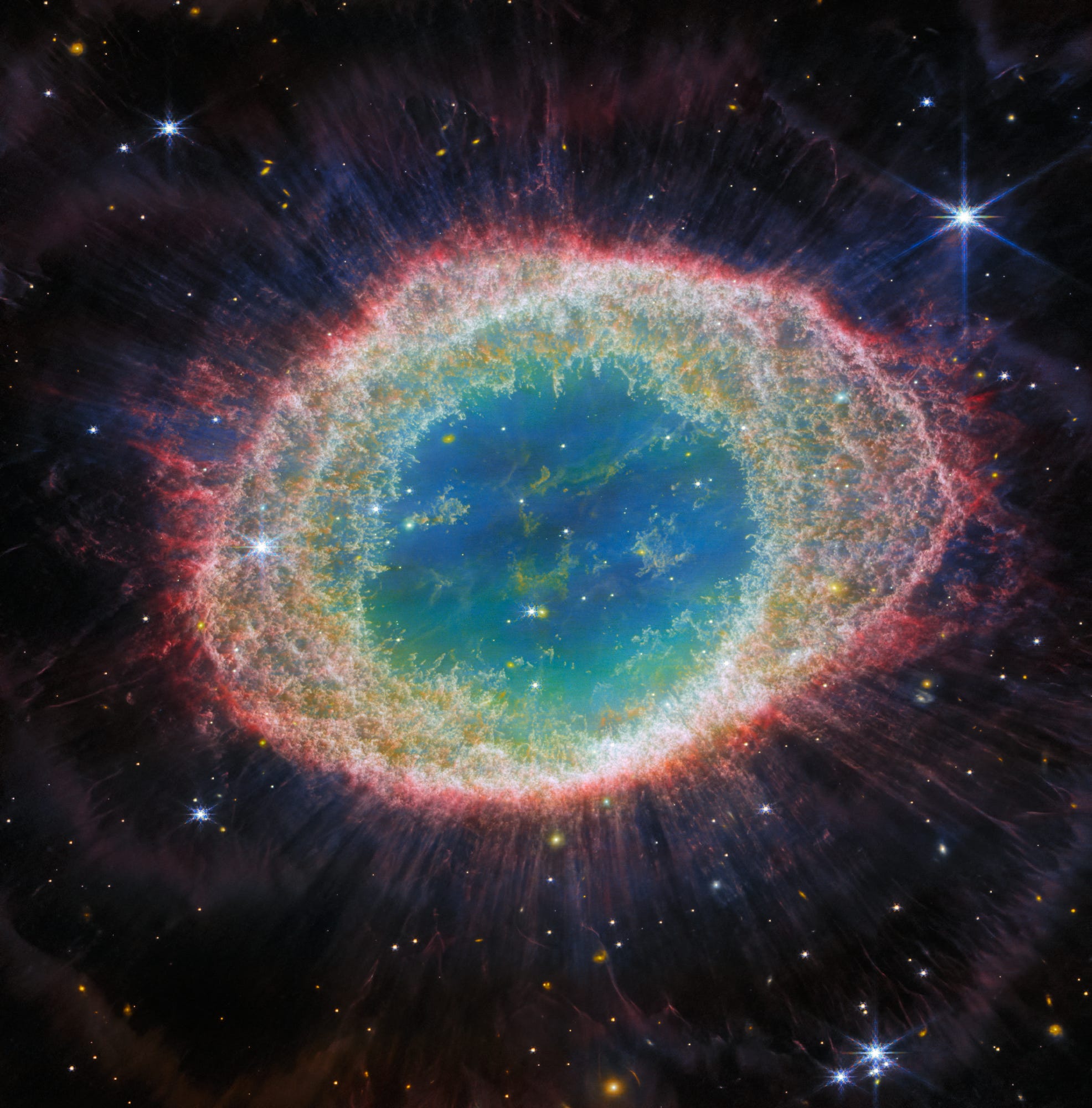
A popular target for amateur astronomers on summer nights is a planetary nebula that gives us a glimpse of the Sun’s future: the Ring Nebula, also known as M57.
Planetary nebulae, in fact, have nothing to do with planets. The name we use for this class of objects is a holdover from the past, when early astronomers thought they were seeing gaseous planets through their now-antiquated telescopes.
We now know planetary nebulae are made when low-mass stars reach the ends of their lives. As many as 97% of the stars in the Milky Way, including the Sun, will form planetary nebulae during their stellar evolution. This means — even as it dies — the Sun will be a thing of beauty.
How and why will all these stars die? It has to do with the inevitable conclusion of the process through which stars generate energy: fusion.
To produce fuel, stars fuse hydrogen, the lightest and most basic element, for most of their lives. Once a star exhausts most of its hydrogen, it begins fusing heavier and heavier elements to produce energy.
As low-mass stars like our Sun finish fusing most of their hydrogen, they quickly burn through concentric shells of helium. This sudden release of energy causes the star’s outer layers to puff out and expand, increasing its size and forming a red giant. In about 5 billion years, when the Sun enters its red-giant phase, it will expand to more than 180 million miles in diameter — roughly the size of the Earth’s orbit, and 200 times larger than it is now.
Once the Sun and other low-mass stars have finished fusing helium into carbon and oxygen, the fusion process will shut down. As these stars shed their outer atmospheres, their cores will collapse, forming a dense stellar remnant known as a white dwarf.
Packing up to 1.4 times the mass of the Sun into an object the size of the Earth, a white dwarf is still blazing hot and radiating energy. This radiation illuminates the outer layers of the star as they drift away into space — creating a planetary nebula.
Planetary nebulae come in a wide variety of shapes and colors; an online search will reveal an infinite variety in infinite combinations. Many of these are visible with amateur telescopes, including M57 — the Ring Nebula.
The Ring Nebula, in the constellation Lyra, is easy to find, and looks fantastic through an amateur telescope.
To see it, first look for Vega — the brightest star in the constellation Lyra — high in the east after dark. Vega is the fifth-brightest star in the night sky, so it should be easy to see with the naked eye. If you need, use an astronomy app or star chart to pinpoint Vega’s location, then find the Ring Nebula within Lyra.
The Ring Nebula really does look like a ring and is interspersed with wisps of nebulosity. I see the ring as mostly green with a red accent, while others see M57 as blue. How will you see this foreshadowing of the Sun’s future?
The Weekly Roundup:
The Morning Sky
Mighty Jupiter shines brightly as it climbs higher in the eastern morning sky each day, drawing ever closer to blazing Venus. These two brilliant worlds will come together next week, giving binocular users an early-morning treat. Look for Saturn high in the south before dawn.
The Evening Sky
Vega, in the constellation Lyra, is one of the three stars that form the Summer Triangle asterism. The stars Altair, in Aquila, and Deneb, in Cygnus, form the other two points of the triangle. Mars is low in the west after dark. Saturn is entering the night sky, rising around 11 p.m. this week.
Dan Price is a NASA/JPL Solar System Ambassador and informal educator. Have a question about astronomy or space science? Send an email to dan@starpointestudio.com and it might be featured in a future column.